
Exploring Extreme Worlds to Shape the Future of Space and Human Health
How can research on extreme environments inform future space missions and human health? This question framed the first Inter-disciplinary Congress on Extreme Worlds (CIME), organised in partnership with UNIVERSEH, where the alliance also introduced its forthcoming master’s programme in Space Health Engineering, co-developed with the University of Toulouse and ISAE-SUPAERO.
Last october 17th, ISAE-SUPAERO hosted the first edition of the Interdisciplinary Congress on Extreme Worlds (CIME) a local event in partnership with UNIVERSEH – MEDES – Institute for Space Medicine and Physiology – CNES (SpaceShip FR).
Spearheaded by Maëlis Lefebvre (postdoctoral researcher in hu-man factors at ISAE-SUPAERO), Vsevolod Peysakhovich (lecturer and researcher in human
factors at ISAE-SUPAERO) and Safouane Hamdi (endocrinologist specialising in reproduction, Toulouse University Hospital), this unique event brought together researchers, teachers, and professionals passionate about exploring the most extreme environments on our planet… and beyond!
Extreme environments as real-life laboratories
During this special day, six inspiring and fascinating talks were given by experts and personalities involved in various extreme environments, from polar expeditions and deep-sea diving to long-duration space missions:
• Christian Clot: Explorer, co-founder, and CEO of the Human Adaptation Institute remarked that solutions for societal progress depend on our ability to comprehend human behavior and social interactions.
• Stephen Alamo: Emergency Doctor at Toulouse University Hospital & Physician for ESA astronauts, discusses the medical challenges of long-duration manned flights and the development of future missions to Mars.
• Gaëlle Giesen: Doctor of astrophysics, Space Systems Engineer, diver, and skydiver hopes for stronger ties between science and extreme sports, imagining how science could illuminate the physiological aspects of sport.
• Alban Michon: Explorer, guide, and polar diver, founder of Biodusséus and the École des Explorateurs highlighted the role of knowledge transfer in shaping future generations.
• Jessica Studer: Physician, researcher for MEDES (CNES) + ESA at the Concordia Station (Antarctica) pre-sents the results of her research at the Concordia sta-tion in Antarctica, a unique laboratory for studying human behaviour in prolonged isolation.
• Geraldine Parodi: Deep-sea diver, highlighted the similarities between underwater and space exploration: “We can bring our experience to bear on joint innovations.”
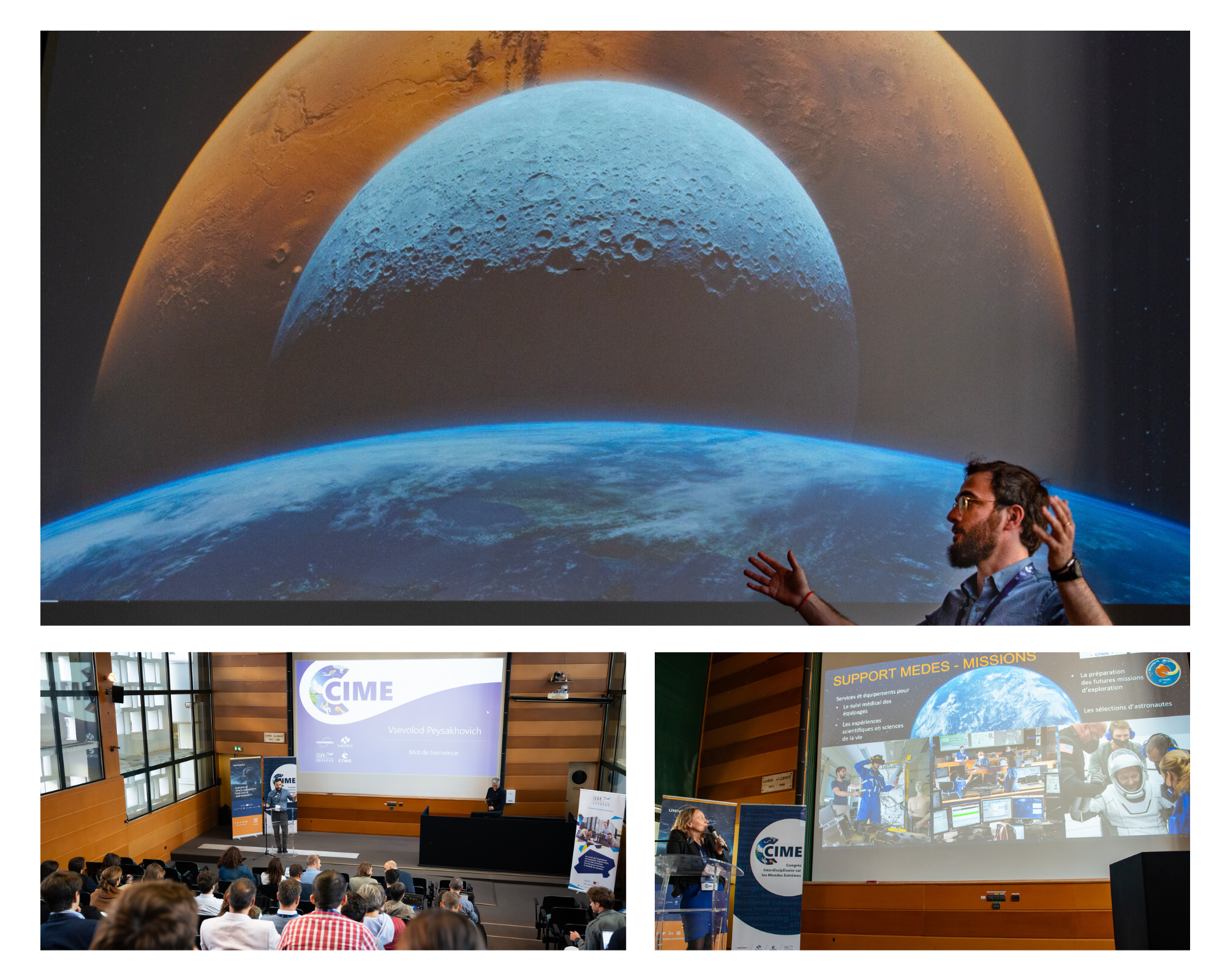
Through the various presentations and captivating stories, the speakers and experts highlighted today and tomorrow’s challenges and inspired new pathways for collaborative and interdisciplinary thinking with remarkable insights and passion.
Advancing education and innovation within the UNIVERSEH alliance
UNIVERSEH’s representatives took the opportunity to share the alliance’s ongoing activities with an audience of experts, stakeholders, researchers, and students, and also had the chance to introduce the future UNIVERSEH master’s degree program in Space Health Engineering in co-development with University of Toulouse and ISAE-SUPAERO.
By bringing together diverse expertise and perspectives, the first edition of CIME illustrates how UNIVERSEH supports interdisciplinary collaboration to address complex challenges at the intersection of space, health and society. The UNIVERSEH alliance looks forward to contributing to future editions of the congress and continuing to expand horizons through shared knowledge and innovation.
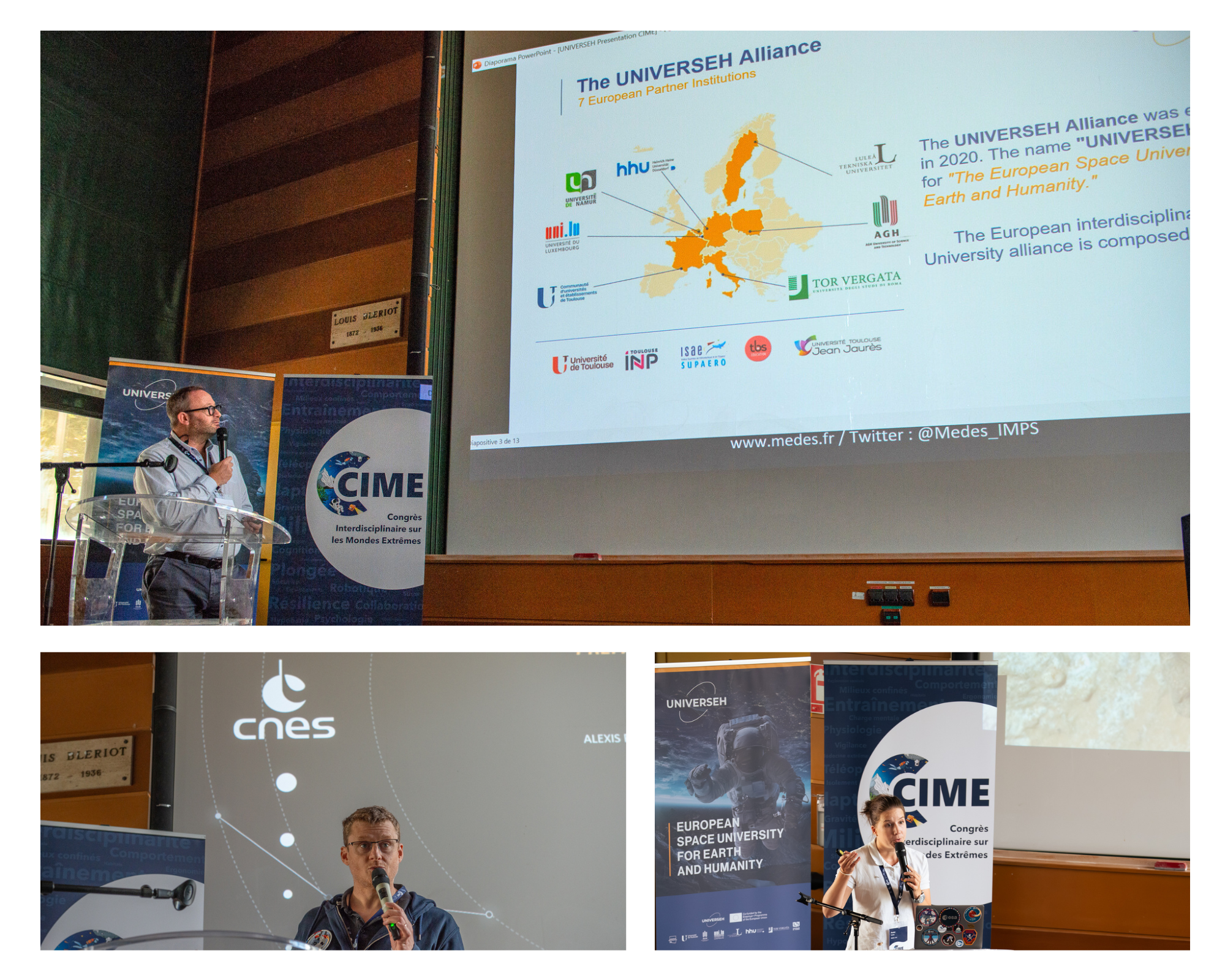
A remarkable congress where explorers, physicians, engineers and researchers shared insights from polar expeditions, deep-sea diving, emergency medicine and space missions, high-lighting how extreme environments serve as real-life laboratories for human adaptation.
The UNIVERSEH team will be delighted to join the next CIME’s edition and with the same enthusiasm and eagerness to continue pushing horizons together.