
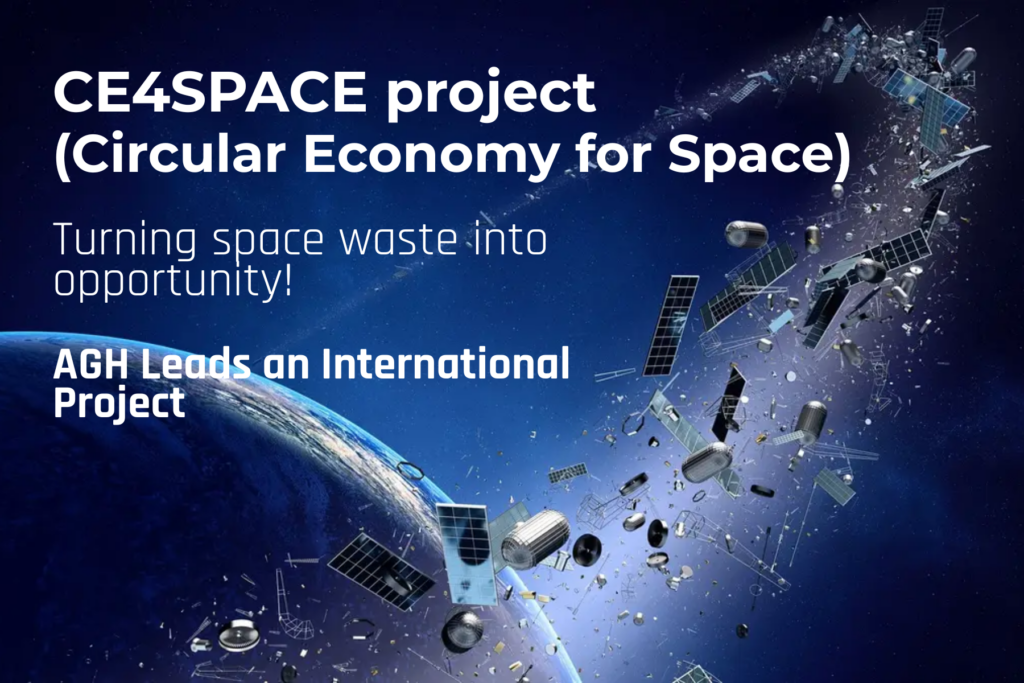
Its budget exceeds €4.5 million, and its goal is to introduce circular economy principles into the exploration and exploitation of outer space.
The project’s outcomes are expected to contribute to environmental protection—both in space and on Earth—and to significantly reduce the costs of future missions.
Challenge: the growing problem of space debris
With the rapid development of the space sector, the number of satellites in orbit and missions to the Moon and Mars is increasing. Currently, most devices are designed in ways that prevent their reuse, leading to a growing accumulation of hazardous space debris.
Transporting new materials from Earth is extremely costly and associated with a large carbon footprint. Therefore, transitioning to a circular space economy is becoming a necessity. The CE4SPACE project aligns with the strategy of the European Space Agency, which under its “Zero Debris Approach” initiative assumes that by 2030 the European space sector will no longer generate new waste.
Solution: the CE4SPACE project
The CE4SPACE consortium will develop innovative scientific, technological, and business solutions aimed at reducing—and ultimately eliminating—the problem of space debris. Activities will focus on three main areas:
Space resources and waste:
- development of technologies for acquiring and processing materials from space debris and local lunar resources (e.g. regolith) to build new infrastructure elements in space;
Technologies for a circular space economy:
- eco-design extending the lifespan of satellites,
- development of active debris removal methods from orbit,
- use of artificial intelligence and robotics to improve mission safety and avoid collisions with space debris;
Business models and legal frameworks:
- design of sustainable and resilient supply chains,
- analysis of geopolitical risks related to dual-use technologies,
- development of new legal frameworks for public-private space partnerships.
Role of AGH and the consortium’s potential
The project is coordinated by the Faculty of Space Technologies at AGH under the leadership of Prof. Tadeusz Uhl. Other AGH researchers involved include Prof. Joanna Kulczycka, Prof. Karol Seweryn, Prof. Waldemar Pichór, and Dr. Agata Harasymczuk.
In addition to AGH, the international consortium includes five renowned universities:
- Durham University (United Kingdom),
- Technische Universität Berlin (Germany),
- Toulouse Business School (France),
- University of Luxembourg (Luxembourg),
- Toulouse Capitole University (France).
The project is also supported by key industrial and institutional partners, including the Mineral and Energy Economy Research Institute of the Polish Academy of Sciences, Creotech Instruments SA, the European Space Foundation, PIAP Space Sp. z o.o., the Space Research Centre of the Polish Academy of Sciences, and Holcim Polska SA.
The combination of science, business, and technology ensures a comprehensive approach to the topic.
Educating future leaders of the space sector
CE4SPACE places strong emphasis on developing the next generation of researchers. As part of the project, an international network will be established employing 15 PhD candidates, including four at AGH laboratories.
Young researchers will gain expertise in space engineering, materials science, economics and management, space law, and future technologies. Equipped with interdisciplinary skills, they will become future leaders shaping the sustainable development of the space sector.