
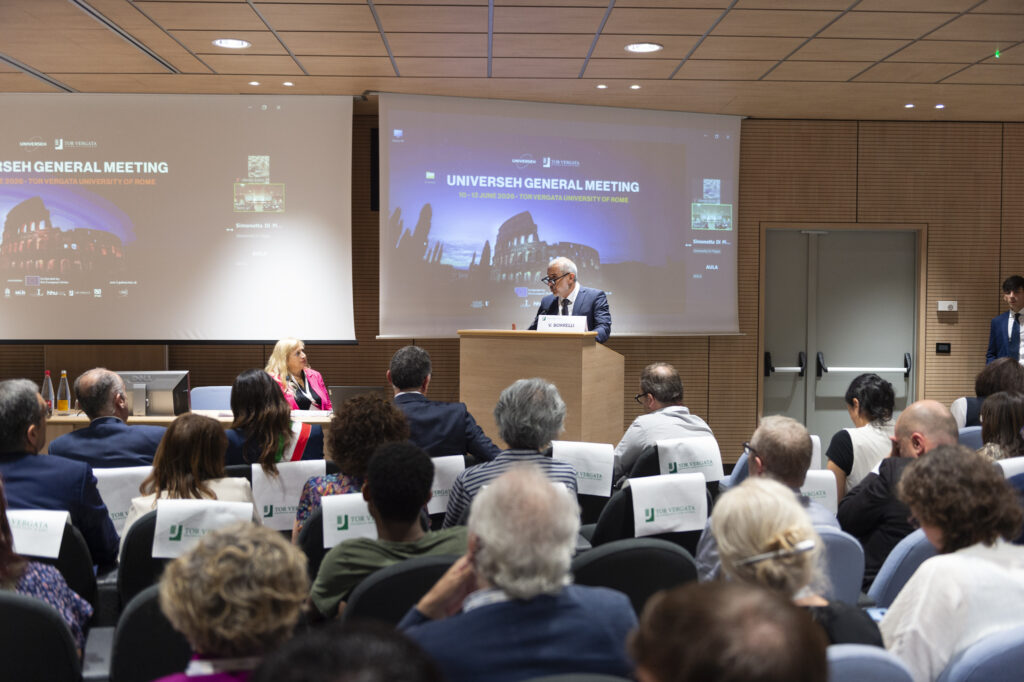
The General Meeting in Rome brought together international researchers to discuss projects, future perspectives, and the state of the art in academic research. The program covered a wide range of topics united by their connection to space and space-related research, including physiology, astronomical meteorology, astronauts, space agencies, and European policies.
European Cooperation, Education and Innovation
The opening session of the General Meeting, featuring several distinguished guests, was moderated by Mirka Zago, Full Professor of Physiology and coordinator of UNIVERSEH 2.0 at Tor Vergata University of Rome.
Welcoming participants was Rector Nathan Levialdi Ghiron, who greeted delegates from universities across Europe:
“It is an honor for our university to host this General Assembly. This is the first time the UNIVERSEH Alliance has met in Rome. I warmly thank all the partners who made this event possible and all of you who traveled from Toulouse, Düsseldorf, Luxembourg, Kraków, Luleå, and Namur to be here.”
The Rector emphasized that the project represents a process of transformation in which universities act as incubators of innovation, creating new knowledge, educational models, and ways of thinking.
He described UNIVERSEH 2.0 as strategically important for Tor Vergata, significantly expanding international opportunities and making exchanges among students, researchers, and staff increasingly dynamic. He also highlighted how European alliances help build bridges, foster dialogue, and encourage future generations to see themselves as citizens of a borderless world.
Recent initiatives such as Tor Vergata nello Spazio (“Tor Vergata in Space”) were cited as examples of the university’s multidisciplinary expertise, spanning engineering, physics, life sciences, artificial intelligence, economics, and law.
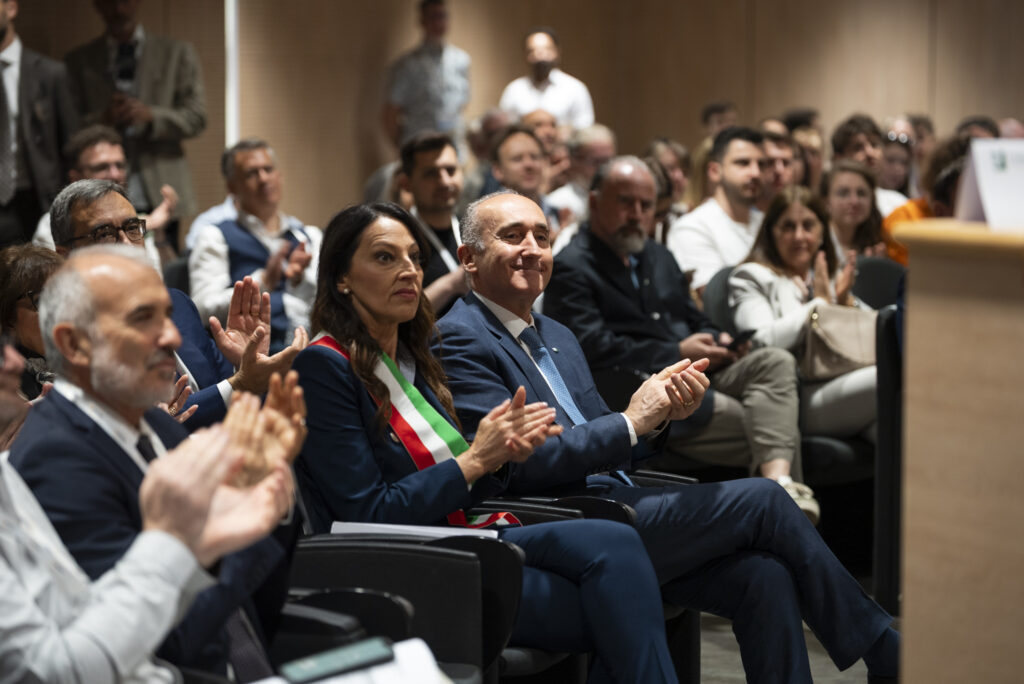
Institutional greetings were also delivered by Svetlana Celli, President of the Rome City Council, representing Mayor Roberto Gualtieri. She stressed Rome’s historical role as a meeting place for people, cultures, and ideas, and praised the university’s scientific and educational excellence.
She described the General Meeting as an opportunity that embodies the core values of the European project: cooperation, openness, knowledge sharing, and relationship-building among institutions, territories, and people.
“You are the beating heart of this journey and the protagonists of tomorrow’s Europe.”
The opening continued with contributions from Michael Toplis, Rector of the University of Toulouse and coordinator of the Alliance, who emphasized the project’s importance within the European context.
Additional institutional perspectives were provided by Vito Borrelli of the European Commission Representation in Italy and Lavinia Monti from Italy’s Ministry of University and Research (MUR), who discussed the evolution of European university alliances, the European Label, and the European Degree initiative.
Valuable contributions also came from Simonetta Di Pippo (SDA Bocconi) and Raffaele Votta (Italian Space Agency – ASI).
The first plenary session, titled “Preparing for the Next Space Age: Human Challenges, Education and Innovation”, was moderated by Bianca Sulpasso, Delegate for Internationalization.
The session offered a broad reflection on the future of space exploration, linking human challenges, education, and innovation through three complementary perspectives.
Mirka Zago highlighted the human dimension of space exploration, drawing on her long-standing research into the physiological effects of spaceflight. As head of Tor Vergata’s Center for Space Biomedicine, she has led studies on microgravity conducted aboard both the Space Shuttle and the International Space Station.
Her work has focused particularly on how the brain adapts Earth-based gravitational references to the space environment, enabling the human body to function in orbit.
Emmanuel Zenou, coordinator of the UNIVERSEH Alliance and professor at ISAE-SUPAERO in Toulouse, outlined the alliance’s structure, origins, and future challenges.
The session concluded with Renato Baciocchi, Vice-Rector for Technology Transfer at Tor Vergata, who discussed how universities can transform research into societal impact and emphasized the importance of building a complete innovation ecosystem, especially in the space sector.
Together, the three presentations reflected the very spirit of the UNIVERSEH alliance: connecting scientific excellence, education, and innovation within a shared European vision.
Throughout the event, activities took place across the university’s Engineering Faculty, the Rectorate, the Italian Space Agency (ASI), and ESA-ESRIN (European Space Agency) in Frascati. Researchers, faculty members, and students participated in plenary sessions, roundtables, and working meetings.
The interdisciplinary nature of UNIVERSEH was further highlighted through activities in the humanities. A workshop dedicated to the languages of space from different disciplinary perspectives was organized by Bianca Sulpasso and Gianluca Fiocco, in collaboration with partners Vincent Simoulin and Yulia Akhmadulina.
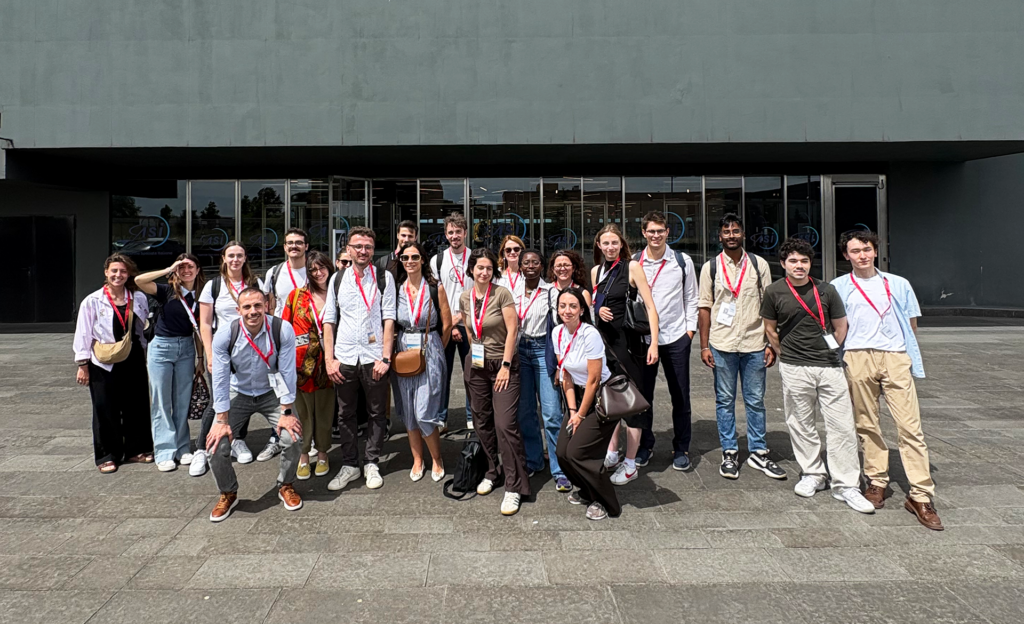
Significant attention was also given to stakeholder engagement initiatives (Bridge to Orbit I and II), the Erasmus Mundus project, and active student participation.
Beyond Earth, for Earth
The program featured three distinguished keynote speakers:
- Giovanni Petri (Northeastern University London), “The Cost of Sharing: From Topological Multitasking Limits to Semantic Horizons”
- Floris L. Wuyts (University of Antwerp), “Brains in Space and Space in the Brain”
- Paolo Nespoli, ESA astronaut, “Beyond Earth, for Earth”
In his keynote address, Nespoli reflected on major space programs and focused attention on what he called “Spaceship Earth.” He traced the history of space exploration from the Space Race of the 1950s and 1960s to the 1969 Moon landing, originally announced by U.S. President John F. Kennedy in 1962.
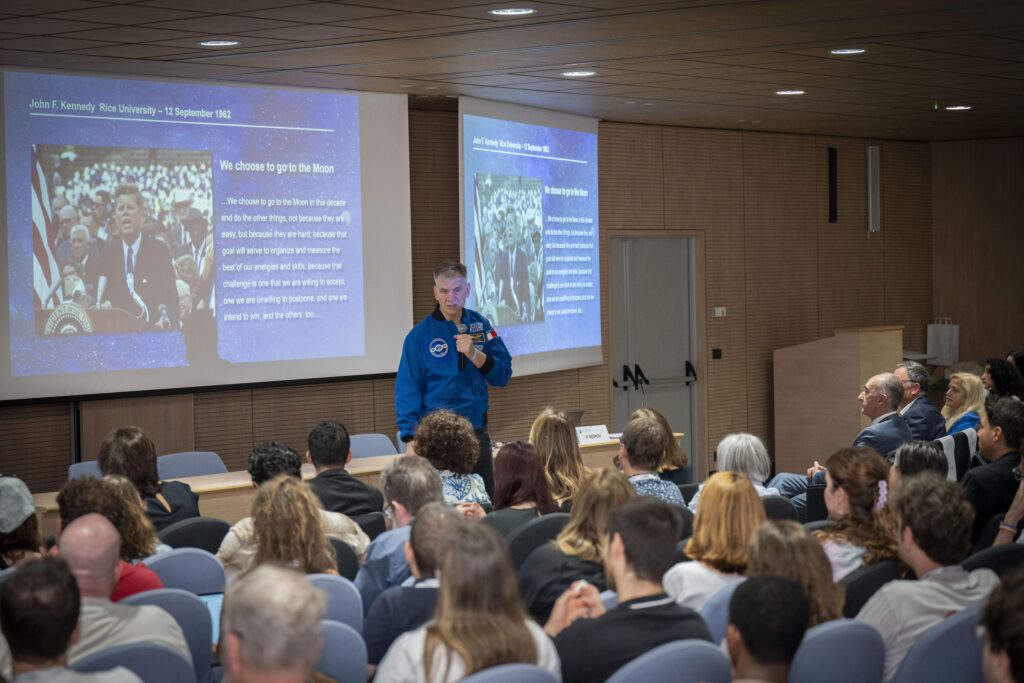
He also discussed the current Artemis Program, NASA’s initiative to return humans to the Moon in collaboration with major international space agencies, including ESA and ASI.
Nespoli shared memories of life aboard the International Space Station (ISS), where he spent more than 300 days across his three missions in 2007, 2010, and 2017, including the VITA mission.
His engaging presentation strongly emphasized the importance of cooperation, a principle that often coexists with intense competition in the space sector. After his talk, he generously spent time with participants, posing for numerous selfies while wearing his astronaut jacket featuring the VITA mission patch.
The message he left to participants and to all those who have followed his missions was simple and powerful:
“We have one Earth. Take care of this Planet.”