
Every year on 26 September, the European Day of Languages, an initiative of the Council of Europe, celebrates linguistic diversity and promotes language learning across Europe. Beyond encouraging multilingualism, the event highlights the role languages play in fostering intercultural dialogue, inclusion, and collaboration in an increasingly interconnected world.
This year, UNIVERSEH marked the occasion with an online programme entitled “Languages Unite!”, bringing together academics, educators, students, and professionals from across the Alliance to explore how languages shape understanding and strengthen connections between people and communities.
The programme featured a diverse range of perspectives:
- From ‘Points of Contact’ to ‘Parallel Universes’ – How Teachers Frame Language(s) in a Multilingual University by Birgit Huemer and Argyro-Maria Skourmalla (Uni.lu)
- Multilingual Students at My University: How Can I Help Them? by Dariusz Kałuża (AGH Krakow)
- The Role Multilingualism Plays in Your Personal and Professional Lives by Senay Akar-Ben Bey (HHU Düsseldorf)
- Life, Love and Languages by Isobel Kersting (HHU Düsseldorf)
- WomenN7 International: Languages as a Gateway to the World by Alexandra Hull and Genevieve Casey (INP France – Toulouse)
- Hands That Unite: Sign Language Transfers Across Communities by Alice Heylens (UNamur)
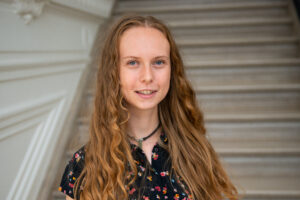
Among the speakers was Alice Heylens, a fourth-year PhD researcher at the University of Namur and UCLouvain (Belgium), whose work focuses on sign language translation and accessibility. Through her presentation, she demonstrated how sign languages can serve as powerful tools for inclusion and social cohesion.
Challenging Misconceptions About Sign Languages
Alice Heylens addresses two common misconceptions: that sign language is universal and that sign languages are merely gestural versions of spoken languages. On the contrary, sign languages are fully developed linguistic systems, each with their own grammar, vocabulary, and cultural dimensions.
Drawing on examples from her research and professional practice, she explored in her presentation how sign language transfer activities, including interpretation, translation, and the creation of new terminology, contribute to stronger connections between deaf and hearing communities.
“Sign languages are fully fledged languages with specific linguistic and cultural properties,” she explained. “Translation, interpreting and the creation of neologisms help bring deaf and hearing communities together.”
Her presentation also highlighted the growing body of research dedicated to sign language translation, demonstrating that translation between signed and spoken languages involves the same level of linguistic complexity as translation between spoken languages.
Language Diversity as a Driver of Collaboration
For Alice Heylens, linguistic diversity is fundamental to successful international cooperation. Whether spoken or signed, languages are at the heart of human interaction and mutual understanding.
“Learning about another person’s language is a way of showing interest in their culture and identity,” she said. “This can only lead to more fruitful and peaceful collaborations.”
She also emphasizes that sign languages broaden our understanding of communication itself, reminding us that meaning is conveyed not only through words but also through gestures, facial expressions, and visual cues.
Accessibility: A Shared Responsibility
International university alliances such as UNIVERSEH can play a key role in advancing accessibility, according to her. By sharing experiences and challenges, institutions can identify common barriers and work collectively toward more inclusive solutions.
“Universities often face similar accessibility issues,” she noted. “Collaborating helps institutions realise that many of these challenges are systemic rather than unique to a single organisation. It also allows them to exchange good practices and develop solutions together.”
Making Space More Inclusive
Accessibility and inclusion are equally important within the space sector, where scientific knowledge and educational opportunities should be available to everyone.
She points out that deaf learners and enthusiasts should be able to engage fully with space-related topics and have access to the terminology needed to discuss them. This is particularly relevant in educational contexts, where scientific concepts, including astronomy and space science, are part of school curricula.
One inspiring example in her presentation comes from a collaboration between the International Astronomical Union and researchers from the Université du Québec à Montréal (UQAM). Working alongside deaf co-researchers and astronomy specialists, the team developed 99 new signs in Quebec Sign Language (LSQ) to represent 47 astronomical concepts. Beyond improving accessibility, the initiative also created valuable opportunities for linguistic research.
Research That Builds Bridges
Through both her academic work and community engagement, Alice Heylens demonstrates how language can be a powerful force for inclusion. Her contribution to the European Day of Languages illustrated that accessibility is not simply about removing barriers. It is about creating opportunities for meaningful participation, ensuring that knowledge, education, and scientific discovery are open to everyone.
Readers interested in exploring this topic further can consult Alice Heylens’ latest open-access publication in The Interpreter and Translator Trainer.
Watch her full presentation below: